
Building Refurbishment. The Risk Is in the Walls.
Refurbishment cost overruns are not inevitable. They result from contracts that do not allocate risk properly, quantities that were not validated, and variations that were not controlled. Reltic addresses all three.
WHY INDEPENDENT MATTERS
The Building Sets The Risk. We Control It.
Refurbishment cost overruns are not inevitable. They result from contracts that do not allocate risk properly, quantities that were not validated, and variations that were not controlled. Reltic addresses all three.
Defensible Quantities
Quantities validated against survey data and design proposals before they reach the contractor.
Refurbishment Cost Plan
Contingency structured around known risk - not applied as a generic percentage across the scheme.
Contract Risk Review
Contract structure reviewed independently before the contractor is appointed to the project.
Site Change Control
Scope changes arising from site conditions managed with the same rigour as design changes.
Final Account Control
Independent representation at close out when contractor claims are typically at their highest.
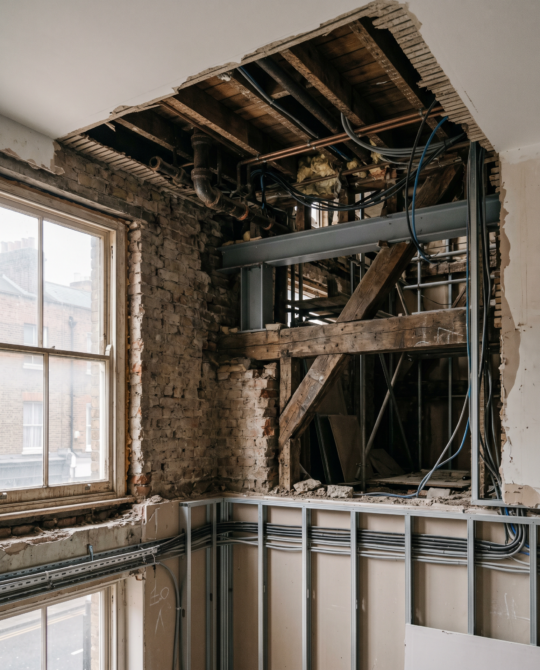
The building holds risks that no survey fully captures.
Refurbishment projects are commercially unpredictable by nature. Surveys reveal less than the building holds. Contractors price risk into their returns – and if the contract doesn’t control how that risk is managed, the client carries it regardless.
Independent Commercial Management on Building Refurbishment Projects
See how Reltic has protected cost certainty and contract position across complex refurbishment and adaptive re-use schemes throughout the UK.
Digital Cost Planning
BIM Quantity Intelligence
Strategic Procurement
Construction Cost Control
Change & Variations
Final Accounts & Disputes
Before the Contract Is Signed, Not After the Building Is Opened Up.
Contract risk allocation is a decision, not a design one.
On refurbishment projects, what’s in the contract – and what’s excluded – determines who carries the cost when conditions change on site. That’s a commercial decision that needs independent scrutiny before the contractor is appointed. We can also step in mid-project when the cost position has become unclear.
Pre-Contract Engagement
Contract structure and risk allocation reviewed independently before appointment – when there is still commercial leverage to protect the client.
Mid-Refurbishment Support
Hidden conditions changed the cost position on site? We rebaseline, establish what is properly in variation and take control of the commercial narrative.
Commercial Control Before the Building Opens Up.
On refurbishment, the risk profile changes the moment work starts on site. This is how we get ahead of it before the contractor is appointed.
Set Brief
Validate What Is Known
Structure the Contract
Control What Changes
Building Refurbishment – Frequently Asked Questions
Quick answers to the most common questions about independent commercial management on refurbishment and adaptive re-use projects.
Defensible quantities without a full survey - how?
Refurbishment always goes over budget. Is there anything you can actually fix?
Can you help if the project is already on site and the cost position is unclear?
Site condition variations - how do you handle them?
Do you advise on contract form for refurbishment projects?



Contact With Us!
Office 676,60 Tottenham Court Road,Fitzrovia,LondonW1T 2EW
Call us: 020 3576 2851
Email: office@reltic.co.uk
Copyright © 2026 Reltic Construction Consultants Ltd. All rights reserved.