Phase Two Inherits What Phase One
Failed to Define.
On complex phasing projects, commercial ambiguity does not stay contained. Consequently, every quantity gap, every unresolved scope boundary and every undocumented assumption compounds across each subsequent phase.
What are your needs?
A Baseline Built for Phasing
You need a quantity structure designed from the outset to survive design changes, programme adjustments and contractor handovers. Furthermore, one that does not need rebuilding from scratch at the start of each phase.
Phase Boundaries Defined
You need scope, quantities and costs clearly established at each phase transition before the next phase begins. Additionally, without that discipline, phase two starts where phase one's problems ended, not where the design intended.
Ambiguity Resolved Early
You need quantity assumptions identified and resolved at the earliest possible stage. Moreover, every assumption carried forward from one phase to the next increases commercial exposure at final account significantly.
Programme and Cost Aligned
You need a programme and cost plan reconciled with each other at every phase gate. Therefore, acceleration pressure in later phases does not generate cost claims that were never anticipated in the original baseline.
The Earlier the Engagement
the Lower the Cost of Control
On complex phasing projects, the cost of establishing a robust commercial function at feasibility is a fraction of the cost of reconstructing one at dispute. Consequently, the clients who engage Reltic earliest tend to have the most straightforward final accounts. Not because their projects were simpler, but because the commercial foundations were laid correctly from the start.
In practice, this means a digital cost planning baseline built at feasibility with a quantity structure designed to track across phases. It means BIM quantity intelligence applied at each design stage to verify that scope assumptions are consistent with the evolving model. Furthermore, it means phase boundaries defined commercially before contractor handovers, so that the change and variations position entering each new phase is clear and agreed by all parties.
Before Procurement
Quantity baseline established at feasibility, structured to survive design changes, programme adjustments and contractor handovers across the full phased programme.
At Each Phase Gate
Scope, quantities and costs reconciled at each transition. Ambiguity resolved before the next phase begins, not accumulated and disputed at final account.
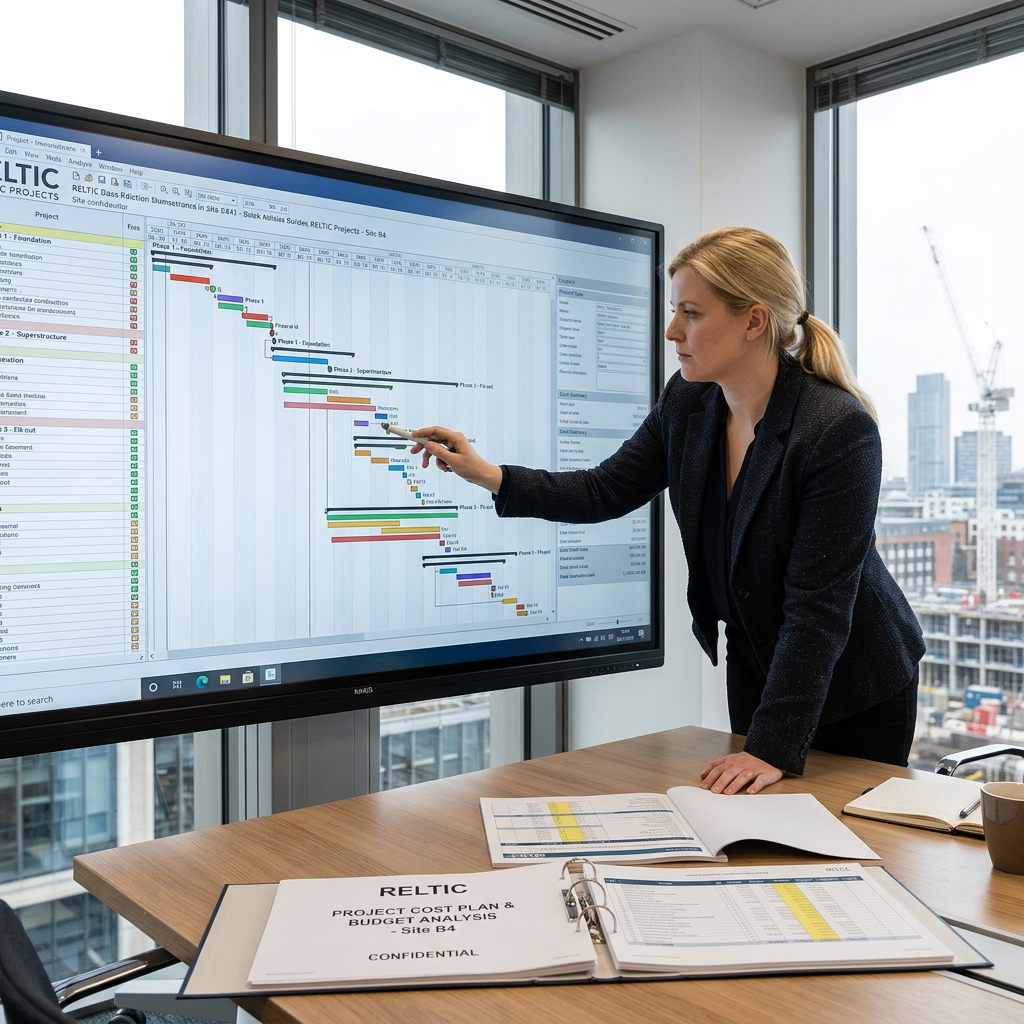
Independent Commercial Control on Complex Phasing Projects across the UK.
Typical programme structure
Baseline fully embedded
Feasibility to final account
First position established
The Phased Schemes Where Early Engagement Matters Most.
High-End ResidentialHigh-End Residential Projects
High‑value residential schemes need tight coordination between design intent, programme and commercial control.
Digital construction analysis gives early visibility of quantity assumptions, procurement exposure and delivery risks before construction begins.
Typical commercial pressures
- Complex coordination between multiple trades
- Programme constraints on tight, complex sites
- Cost plans based on incomplete design information
- Contractor pricing volatility
Complex Phasing Projects
Phased construction programmes need disciplined coordination between sequencing, access, logistics and commercial risk.
Digital construction analysis exposes assumptions, procurement exposure and delivery risks across phases before work starts.
Typical commercial pressures
- Programme instability across phased construction
- Site logistics constraints and delivery sequencing
- Coordination between contractors and trades
- Late-stage variation exposure across phases
Mixed-Use Developments
Mixed‑use developments demand precise coordination between different asset classes, programme logic and commercial control.
Digital construction analysis highlights cost, procurement and delivery risks across uses before construction begins.
Typical commercial pressures
- Coordination between retail, residential and other uses
- Programme sequencing where uses open at different times
- Procurement exposure across many specialist packages
- Cost planning complexity as value and spec vary by use
When quantities are established independently, traced to the model and documented from the start, the final account is not a negotiation. It is a reconciliation.
That is the difference between a cost plan that holds and one that does not.
The Final Account on a Phased Project
Reflects Every Decision Made at Feasibility.
When a quantity baseline is not established properly at the start of a phased programme, the consequences do not appear immediately. They appear at the end of phase one, when the scope boundary with phase two has not been commercially defined. Subsequently, they appear again at the end of phase two, compounded by everything that was not resolved the first time.
Furthermore, by the time the final account opens on a multi-phase programme, the cost of late engagement has already been paid many times over. That is why independent construction cost control applied from feasibility on programme sequencing risk and phasing coordination failure is not a premium. It is the most cost-effective commercial decision on the programme.
Present at Feasibility.
Continuous through Final Account.
› Quantity baseline built to survive design changes and handovers
› Phase boundaries defined commercially before each transition
› Final account supported by evidence established at the start
Independent Commercial Control on Complex Phasing Projects. From Feasibility Onwards.
If your phased project does not yet have a quantity baseline designed to survive each phase transition, the commercial exposure is already accumulating. As an independent quantity surveyor working exclusively on the client side, we establish that baseline before it matters. See how this applies on projects with phasing coordination failure and programme sequencing risk.



Contact With Us!
Office 676,60 Tottenham Court Road,Fitzrovia,LondonW1T 2EW
Call us: 020 3576 2851
Email: office@reltic.co.uk
Copyright © 2026 Reltic Construction Consultants Ltd. All rights reserved.