


Introduction: when design ambition meets commercial risk
Prime residential townhouses, penthouses and one‑off refurbishments across the UK are rarely straightforward. Design ambition, heritage constraints and demanding neighbours often collide with tight budgets and fixed completion dates. On top of that, both clients and contractors expect a level of certainty that traditional 2D‑based quantity take‑offs struggle to deliver.
This is where our BIM Quantity Intelligence service changes the commercial conversation. Instead of treating the BIM model as a nice‑to‑have visual, we use it as the backbone for quantities, risk and commercial decisions on high‑end residential projects across the UK, including London and other major city‑centre locations.
We most often apply this approach on prime residential schemes , working with Project Teams , Main Contractors and Capital Partners who carry real commercial risk.

What we mean by BIM Quantity Intelligence
Most project teams now say they are “using BIM”. In reality, on many prime residential projects the model looks impressive, but no one fully trusts it for money. Our BIM Quantity Intelligence service is built to close that gap.
For us, BIM Quantity Intelligence means:
- Starting from 3D models, not just 2D drawings, but never blindly trusting either.
- Building clear, defensible rules for how quantities are measured from the model.
- Using 4D thinking to tie scope to phasing, access and preliminaries.
- Applying 5D cost logic so every key element has both geometry and value behind it.
In practice, this lets us produce model‑based quantities that a QS, a Main Contractor and a Capital Partner can all rely on.If you want the bigger picture of how this fits into our wider service offering, you can also look at Digital Cost Planning and Construction Cost Control.

Why traditional approaches fall short on prime residential projects
High‑end residential projects across the UK bring a specific mix of risks:
- Complex bespoke finishes and joinery that change late in the day.
- Neighbour, rights‑of‑light and logistics constraints that limit what you can build and when.
- High client expectations on design quality and programme, with limited tolerance for cost drift.
On many schemes we walk into, quantities come from 2D drawings that have been superseded, models built for visualisation rather than measurement, and spreadsheets no one has reconciled with the latest design. The result is predictable: scope gaps, duplicated items and blunt allowances that are hard to rely on when you are signing a JCT contract or negotiating variations.
That is exactly why we pair BIM Quantity Intelligence with clearer packaging and change processes through our Strategic Procurement and Variation & Change Control services .
Our process: from messy model to defensible quantities
We structure BIM Quantity Intelligence as a step‑by‑step process so you always know where you stand on data quality and risk.
4.1 Model audit and readiness check
Before we touch quantities, we review the model:
- We check LOD/LOI for measurement – whether elements are modelled as they will be priced.
- We compare the model with current drawings and specifications.
- We flag missing areas such as temporary works or detailed joinery.
At this stage, we are clear about where the model can safely be used and where traditional QS methods or targeted allowances remain necessary.
4.2 Measurement rules and structure
We then agree measurement rules:
- Which elements are measured from the model and which from drawings or specs.
- How we break elements down into work packages.
- How we code items so cost reports, dashboards and the final account line up.
This ties directly into how we support Strategic Procurement and Construction Cost Control.
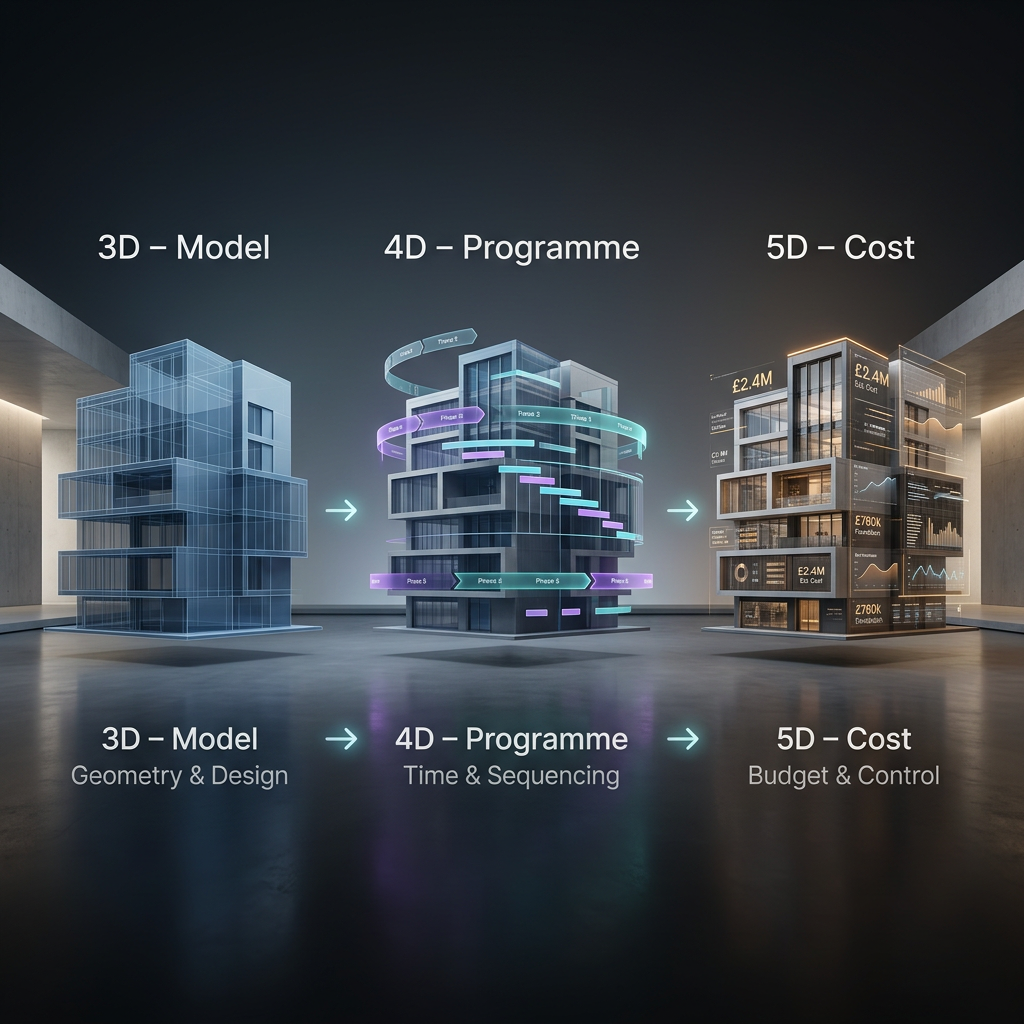
4.3 3D/4D/5D integration
Next, we connect the dimensions:
- 3D to give a shared visual view of scope.
- 4D to link elements to phasing and programme.
- 5D to attach real costs and rates to each package.
At this point, BIM stops being a presentation tool and becomes a hard commercial tool closely linked to our live cost control approach.
Typical problems we solve on prime residential schemes
Across prime residential schemes in the UK, we see the same patterns repeat. BIM Quantity Intelligence is designed to address them directly.
Scope gaps between design and tender documents
Elements appear in the model but not in the specification – or the other way round. Bidders patch this with “priced assumptions”, which later come back as variation disputes. We build clear “in / out” scope lists and support the team in writing Employer’s Requirements and handling tender queries, working hand‑in‑hand with our Strategic Procurement service.
Late design changes that blow the budget
On prime schemes, clients often change their mind once they see something in 3D. If quantities are static, the cost plan quickly stops being relevant. By connecting model‑based quantities to Digital Cost Planning , we update the cost position at key design change points and show the impact of options before decisions are locked in.
Disagreements over variations and final account
If there is no shared quantity baseline, every variation becomes a potential dispute and the final account drags on. We use the model as a common baseline and link changes in models, drawings and site instructions to quantities and valuation, supporting both Variation & Change Control and Final Account & Dispute Support.
What this looks like for Main Contractors
Main Contractors on prime residential projects carry real commercial risk. They need more than generic “BIM support”.
From a contractor’s perspective, BIM Quantity Intelligence provides:
- Defensible quantities that can be put in front of clients and Capital Partners.
- Stronger justification for variations – with both visual and quantitative backing.
- Alignment between the model, valuations and forecast final account.
In practice, that means fewer arguments over what was in the contract, quicker agreement on changes and a stronger position at final account, especially when combined with Construction Cost Control and Final Account & Dispute Support.
What this looks like for Project Teams and Capital Partners
On the client side – whether you are leading the scheme as a Project Team or providing funding as Capital Partners – visibility and direction are more important than every measurement detail.
For Project Teams, BIM Quantity Intelligence :
- Translates complex models and quantities into clear, decision‑ready reports.
- Highlights where the real cost risks are, and what is just noise.
- Provides an independent view that can be set against contractor data.
For Capital Partners, the same data makes it easier to test drawdowns, monitor risk and understand how design and programme decisions affect the funding case.

A typical engagement on a prime UK scheme
A typical engagement on a prime townhouse or apartment scheme in a UK city might follow this sequence:
- Kick‑off review of the model, drawings and existing cost plans.
- Model audit and readiness check.
- Agreement of measurement rules and coding.
- Initial 5D model aligned with work packages and the cost plan.
- Tender support alongside Strategic Procurement.
- Live updates linked to Construction Cost Control.
- Change and variation support tied into Variation & Change Control.
- Final account support through Final Account & Dispute Support.
This shows how BIM Quantity Intelligence sits at the centre of a joined‑up commercial approach.
Is BIM Quantity Intelligence right for your project?
BIM Quantity Intelligence is most valuable when:
- Design ambition and customisation are high.
- The project is sensitive to delay and disruption.
- Commercial risk is real for Main Contractors, Project Teams or Capital Partners.
- BIM is already in use, but not fully trusted for money decisions.
If that sounds like your scheme – whether in London, Manchester, Birmingham, Edinburgh or any other UK city – you are exactly the kind of prime residential project we built this service for.
What to do next
If you are planning or delivering a prime residential project anywhere in the UK and want a BIM‑led, defensible view of your quantities and commercial risk, we suggest starting with a short review of your current model and documentation.
You can read more about our BIM Quantity Intelligence service here , or see how it connects with Digital Cost Planning , Construction Cost Control , Variation & Change Control and Final Account & Dispute Support .
If you would like to discuss a specific project, get in touch [link to contact page]. We can review your current position, show you what BIM Quantity Intelligence would look like on your scheme, and agree a level of support that matches your risk profile.